cognos-banner-bg
cognos Platform focus

THE COGNOS MIGRATION
PROBLEM IS CHANGING

Cognos environments can accumulate years of reports, packages, Framework Manager models, data modules, data sources and security settings. Moving them has traditionally meant substantial discovery, analysis, rebuilding and validation. A new generation of migration approaches is beginning to change how that work gets done.

Sponsored by USEReady

MigratorIQ uses five specialized AI agents to automate legacy BI migration, while USEReady engineers govern critical handoffs and ensure production readiness.

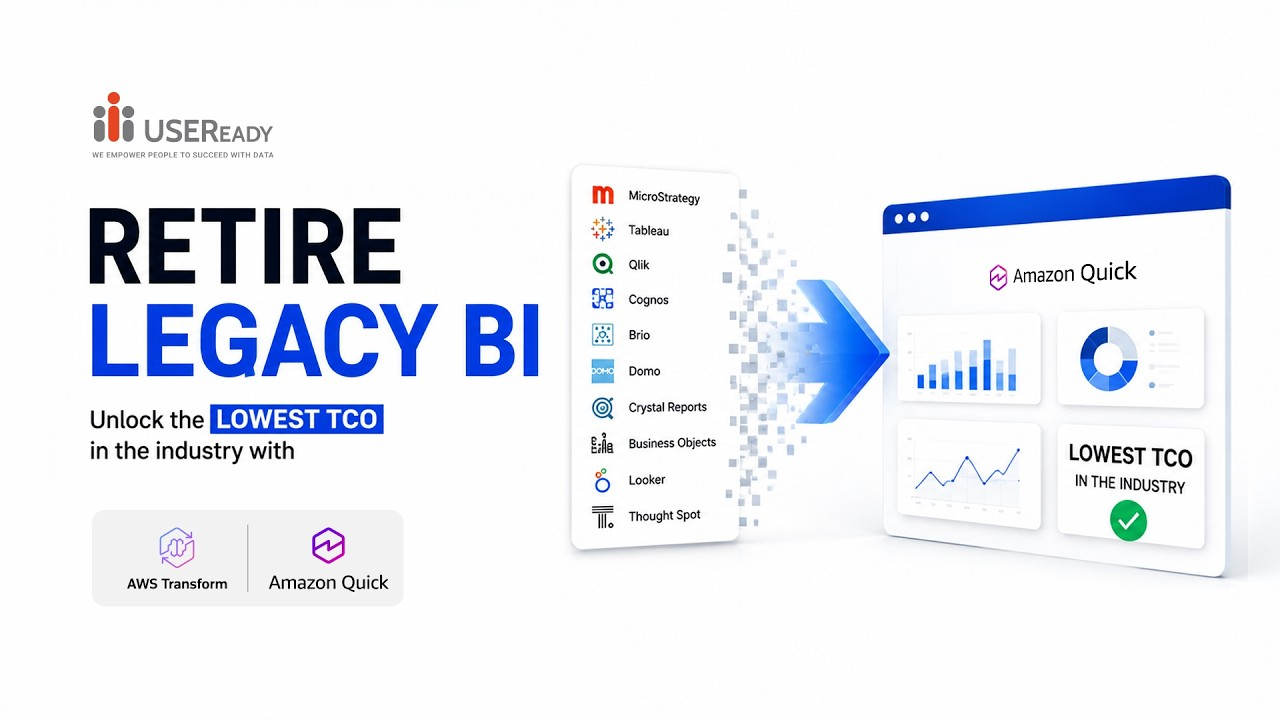
Retire legacy BI: unlock the lowest TCO in the industry with AWS Transform and Amazon Quick
The difference

Why Cognos migration is different

A Cognos environment is built around more than reports. Reports can reference published packages, while packages can be based on metadata models created in Framework Manager. Cognos Analytics also supports data modules as a metadata modeling environment, creating another layer of models and dependencies within the estate.

That makes the migration problem less about moving individual reports and more about understanding the structure behind them. What package does a report depend on? Which model or data module provides its metadata? Which data sources need to change? Which content is still in use? And which parts of the estate no longer need to make the journey? IBM documents cases where migrated reports can lose their package references when the underlying package or security context is not available in the target environment.

Video Cognos migration: what changes with an agentic approach Watch Now
The estate

The Cognos estate is more than reports

Before anything can be migrated, the estate itself has to be understood. That means looking beyond individual reports to packages, models, data modules, data sources, security and dependencies underneath the reporting layer.

A Cognos environment can contain reports that depend on published packages, while those packages may depend on Framework Manager models or data modules and their underlying data sources. Report specifications also contain the structural definition of a report, while package and object security can determine whether migrated content can be accessed and used.

icon-star Some content may be heavily used.
icon-boxes Some may depend on shared packages or models.
icon-shield Some may carry security requirements.
And some may no longer have a reason to exist.

The challenge is therefore not simply to inventory the estate, but to understand it well enough to decide what should move, what should be rebuilt, and what should be left behind.

The model

How the Cognos migration model is changing

The objective remains the same: understand the Cognos estate, determine what needs to move, rebuild it on the target platform, and validate the result. What has changed is how the work can be performed.

Traditional migration

People at the center
traditional-migration-model
Discovery Analysis Migration Rebuild Testing

Specialist teams drive the work, often sequentially, with people responsible for understanding reports, packages, models, data sources, dependencies and business logic across the migration.

Migration accelerators

Automation supporting people
migration-accelerators-model
Automated discovery Conversion accelerators Metadata processing Report generation Testing

Repeatable parts of the migration can be automated, reducing manual effort while people continue to orchestrate the overall process.

USEReady's Approach

Agentic migration

Specialized agents working in parallel
agentic-migration-model Powered by MigratorIQ
Discovery Migration Semantic Validation Compatibility

AI agents can take on specialized migration workloads and work across multiple stages, while human experts provide oversight, judgment and exception handling.

USEReady's Agentic Migration Model

Powered by MigratorIQ, five specialized AI agents handle discovery, migration, semantic intelligence, validation, and enterprise compatibility, while human experts oversee critical handoffs and production delivery.

Destination platforms

Three destinations. Different paths to modern BI.

The right destination depends on your existing technology ecosystem, business needs, and vision for analytics. Each platform offers a different path to modernization.

Amazon Quick

Cloud-native analytics at scale

A modern, serverless BI platform that fits naturally into the AWS ecosystem, with built-in security, scalability, and a cost-efficient path to modern analytics.

destination-aws-art

Microsoft Power BI

Analytics across the Microsoft ecosystem

A powerful, integrated BI platform for organizations invested in Microsoft, with seamless connectivity, familiar tools, and broad business adoption.

destination-powerbi-art

Tableau

A proven platform for visual analytics

A powerful, integrated BI platform for organizations invested in Microsoft, with seamless connectivity, familiar tools, and broad business adoption.

destination-tableau-art